domingo, 29 de septiembre de 2019

1995 International Mathematical Olympiad, problem 1


Proof. Notice that because of the Radical Axis theorem, the  quadrilateral $BCMN$ is cyclic. It follows that $\angle{BCM}=\angle{BNM}$. Observe that $\angle{MAC}+\angle{BCM}=90^\circ$ ($\triangle{ACM}$ is a right triangle). It turns out that $AMND$ is cyclic. Indeed, $\angle{MAD}+\angle{MNB}+\angle{BND}=180^\circ$.
Now, by the Radical Axis theorem, $AM$, $ND$ and $XY$ must concur.


domingo, 15 de septiembre de 2019

Un problema que involucra excírculos

El problema consiste en demostrar que $EF$ y $GH$ se intersecan en $AC$.


Demostración: Si $EF$ interseca a $AC$ en $P$, será suficiente probar que $H$, $G$ y $P$ están alineados. Por el teorema de Menelao, el problema queda resuelto si probamos que

$$\frac{AG}{GB}\cdot{\frac{BH}{HC}}\cdot{\frac{CP}{PA}}=-1$$


Note que $GB=BH$, por lo que la expresión $\frac{AG}{GB}\cdot{\frac{BH}{HC}}\cdot{\frac{CP}{PA}}=-1$ queda reducida a 

$$\frac{AG}{HC}\cdot{\frac{PC}{PA}}=-1$$ 

Note también que $AG=DA$ y $HC=DC$. Así, reescribiendo,

 $$\frac{DA}{DC}\cdot{\frac{PC}{PA}}=-1$$

Pero los puntos $A$, $C$, $D$ y $P$ forman una cuaterna armónica, por lo tanto, $-\frac{PA}{PC}=\frac{DA}{DC}$. De modo que 

$$\frac{DA}{DC}\cdot{\frac{PC}{PA}}=-\frac{PA}{PC}\cdot{\frac{PC}{PA}}=-1$$

$\square$

Problema del libro "Geometry in Figures" de Arseniy Akopyan.

sábado, 27 de julio de 2019

Propiedades del logo de la ACRD

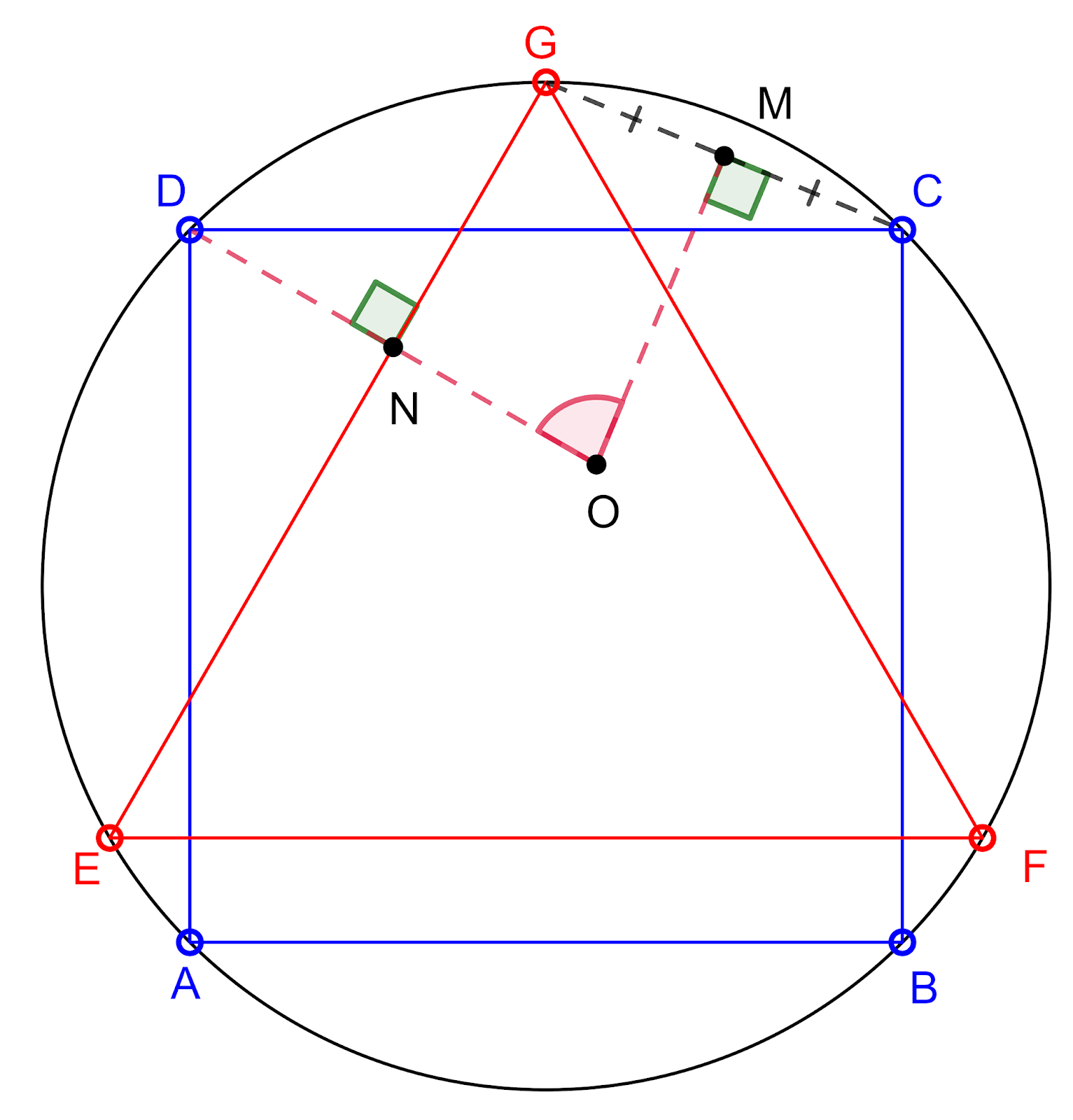
He aquí algunos problemas inspirados en el logo de la Academia de Ciencias de la República Dominicana. La figura consiste en un triángulo equilátero y un cuadrado inscritos en una circunferencia como muestra la figura. Tanto el cuadrado como el triángulo equilátero son simétricos con respecto a un eje de simetría y.

Logo original de la $ACRD$:


Problema 1Si $H$, $I$ y $J$ son puntos medios, demostrar que $\frac{HI}{IJ} = \sqrt{2}$.


Problema 2. Desde $C$, tracemos una línea perpendicular a $FG$ de tal modo que corte al lado $FG$ en $I$ y al lado $EG$ en $J$. Denotemos con $H$ la proyección ortogonal de $G$ en el lado $DC$. Si $CI=a$, $GH=b$ e $IJ=c$, demostrar que $c-a=2b$. 


Problema 3. Llamemos $O$ a la intersección de la mediatriz de la cuerda $CG$ y la perpendicular desde $D$ a $EG$. Si $DO$ corta a $EG$ en $N$, demostrar que $DN=NO$.


Problema 4. $H$ e $I$ son los puntos donde la perpendicular desde $C$ a $FG$ corta los lados $FG$ y $EG$, respectivamente. Si $J$ es la proyección ortogonal de $D$ en $EG$, demuestra que $IJ = GJ$.


Problema 5. Si $M$ es el punto medio de la cuerda $CG$, encuentra la medida del ángulo $\angle{DOM}$.

domingo, 14 de abril de 2019

Solución a un problema propuesto por Chrysanthos Xydas‎

En la figura, $P$, $Q$ y $T$ son puntos de tangencia. Encuentre la medida de $\angle{ATM}$.


Lema 1. Denotemos con $I$ el incentro del $\triangle{ABC}$. Llamemos $M'$ a la segunda intersección de $AI$ con la circunferencia circunscrita de $\triangle{ABC}$. Entonces, $BTIPM'$ es cíclico.


Demostración. Evidentemente, $BTIP$ es cíclico (por ángulos opuestos suplementarios). Note que $\angle{BCA}=\angle{BM'A}=90^\circ$. Pero $\angle{BTI}=90^\circ$, consecuentemente, $BTIPM'$ es cíclico.

$\square$

Lema 2. $M'$, $P$ y $Q$ están alineados. 


Demostración. En un problema que data del 2014 demostré que para cualquier triángulo, $\angle{BIA}=\angle{PQA}$ (ver aquí). Al ser $\triangle{BTI}\cong{\triangle{BPI}}$ y como consecuencia del lema 1, $\angle{TBI}=\angle{ABI}=\angle{IM'P}=\angle{AM'P}$. Pero $\angle{BAI}=\angle{IAQ}=\angle{M'AQ}$, por lo tanto, al ser $\angle{ABI}=\angle{IM'P}$, $\angle{BAI}=\angle{IAQ}$ y $\angle{BIA}=\angle{PQA}$, el ángulo $\angle{M'PQ}$ del cuadrilátero $M'PQA$ debe ser llano, ya que $\angle{AM'P}+\angle{M'AQ}+\angle{PQA}=180^\circ$ . Por lo tanto, $M'$, $P$ y $Q$ están alineados y $M'=M$ (el punto $M$ de nuestro problema original).

$\square$
De vuelta a nuestro problema original, note que $\triangle{M'TA}\cong{\triangle{M'QA}}$ (por el criterio de congruencia $LAL$). Claramente, al ser $\triangle{CPQ}$ un triángulo recto isósceles, $\angle{M'QA}=\angle{M'TA}=135^\circ$. 

$\square$

sábado, 9 de marzo de 2019

Parallel Lines Associated with a Mixtilinear Incircle

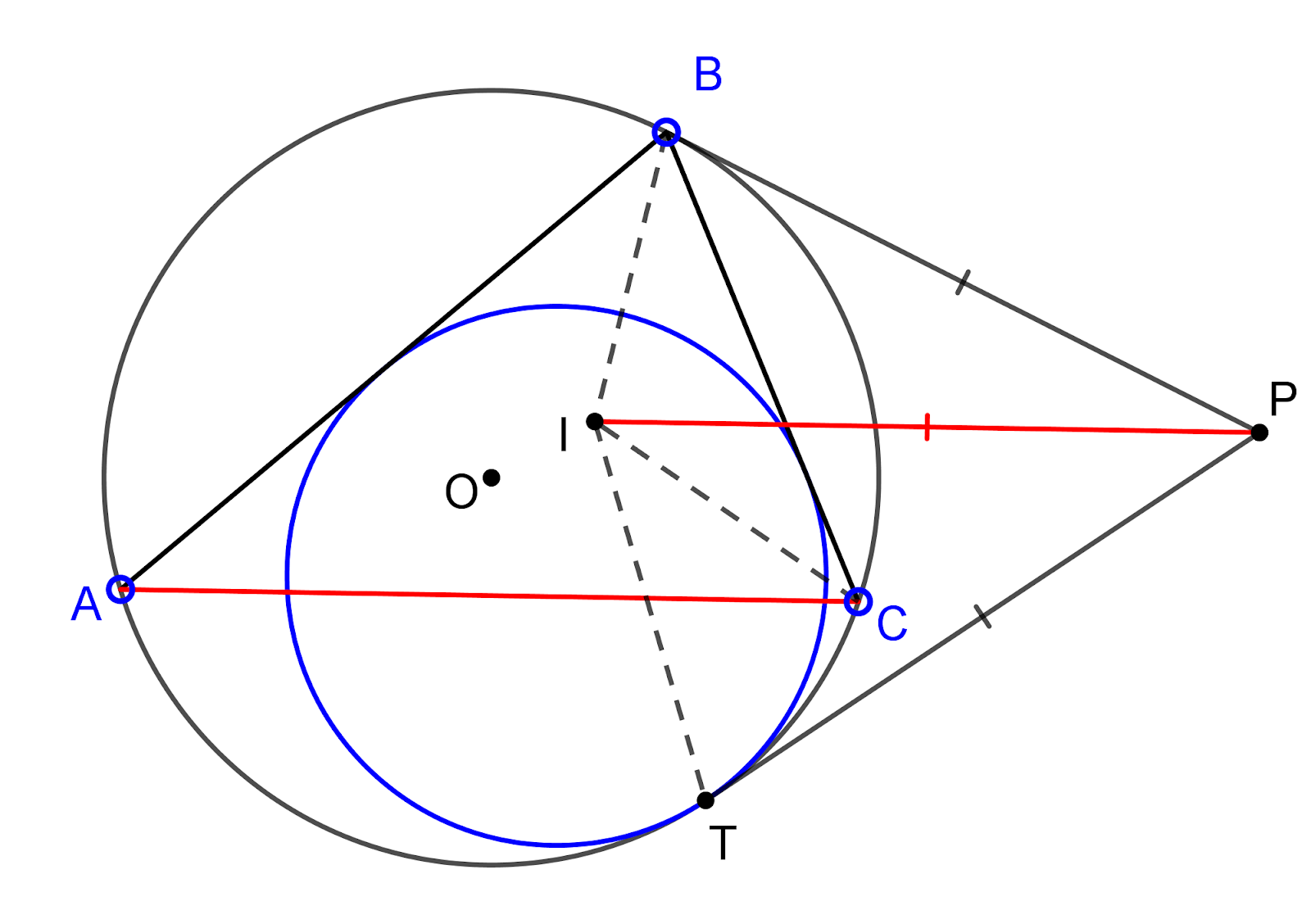
Let $I$, $O$ and $\tau$ be the incenter, circumcenter and circumcircle of triangle $ABC$. The circle $\omega$ is tangent to lines $AB$ and $BC$, and touches internally $\tau$ at $T$. The tangents to $\tau$ at $T$ and $B$ intersect at $P$. Prove that $IP\parallel{AC}$.


Proof. It suffices to show that $\angle{\frac{ACB}{2}}=\angle{CIP}$. We know from lemma 2 in a previous problem that $\triangle{BPI}$ is isosceles with $\angle{IBP}=\angle{BIP}=\frac{\angle{ABC}}{2}+\angle{BAC}$. We have
$$\angle{CIP}=\angle{BIC}-\angle{BIP}=180^\circ-\frac{\angle{ABC}}{2}-\frac{\angle{ACB}}{2}-\frac{\angle{ABC}}{2}-\angle{BAC}.$$
But $180^\circ-\angle{ABC}-\angle{BAC}=\angle{ACB}$. Hence, $\angle{CIP}=\frac{\angle{ACB}}{2}$.


$\square$

viernes, 8 de marzo de 2019

TST Peru, 2019

Let $I$, $O$ and $\tau$ be the incenter, circumcenter and circumcircle of triangle $ABC$. The line $BI$ intersects $\tau$ again at $M$. The circle $\omega$ is tangent to lines $AB$ and $BC$, and touches internally $\tau$ at $T$. The tangents to $\tau$ at $T$ and $B$ intersect at $P$. The lines $PI$ and $TM$ intersect at $Q$. Prove that the lines $QB$ and $MO$ intersect at $\tau$. 

Solution. 

Lemma 1. $\angle{MBT}=\angle{OTI}$.


Proof. By properties of angles in a circle, $\angle{BOT}=2\angle{BAC}+2\angle{TBC}$. As $\triangle{OTB}$ is isosceles, $\angle{OTB}=90^\circ-\angle{BAC}-\angle{TBC}$. Moreover, 

$$\angle{OTC}=90^\circ-\angle{BAC}-\angle{TBC}+\angle{BAC}=90^\circ-\angle{TBC}.$$

$\angle{ATI}=\angle{CTI}$ (This is a well-known property of mixtilinear incircle. See $[1]$ and $[2]$)   and  $\angle{ATC}=180^\circ-\angle{ABC}$, then,  $\angle{ATI}=\angle{CTI}=90^\circ-\frac{\angle{ABC}}{2}$. It follows that 

$$\angle{OTI}=\angle{OTC}-\angle{CTI}=90^\circ-\angle{TBC}-90^\circ+\frac{\angle{ABC}}{2}=\frac{\angle{ABC}}{2}-\angle{TBC}.$$ 

But $\angle{MBT}=\frac{\angle{ABC}}{2}-\angle{TBC}$, therefore, $\angle{MBT}=\angle{OTI}$.


$\square$


Lemma 2. $BP=PT=IP$.


Proof. We already know that $\angle{OBT}=\angle{OTB}=90^\circ-\angle{BAC}-\angle{TBC}$. But $\angle{BAC}+\angle{TBC}=\angle{TBP}$, then, $\angle{OBT}=\angle{OTB}=90^\circ-\angle{TBP}$. Let $R$ be the circumradius, then, by the Law of Sines, 
$$\frac{BT}{\sin{2\angle{TBP}}}=\frac{R}{\sin{(90^\circ-\angle{TBP)}}}$$
$$BT=2R\sin{\angle{TBP}}$$
Focusing on quadrilateral $OBIT$, $\angle{BIT}=360^\circ-\angle{BOT}-\angle{OBI}-\angle{OTI}$. Let $B'$ be the orthogonal projection of $B$ onto $AC$. We have $\angle{B'BC}=90^\circ-\angle{ACB}$. Since $O$ is the isogonal conjugate of the orthocenter, it follows $\angle{OBI}=\frac{\angle{ABC}}{2}+\angle{ACB}-90^\circ$. Moreover, we know from lemma 1 that $\angle{OTI}=\frac{\angle{ABC}}{2}-\angle{TBC}$. Then, 
$$\angle{BIT}=360^\circ-(2\angle{BAC}+2\angle{TBC})-(\frac{\angle{ABC}}{2}+\angle{ACB}-90^\circ)-(\frac{\angle{ABC}}{2}-\angle{TBC}).$$ 
But 
$$\angle{ABC}+\angle{BAC}+\angle{ACB}=180^\circ,$$ 
then,  
$$\angle{BIT}=270^\circ-\angle{BAC}-\angle{TBC}.$$
Now, focusing on $\triangle{BIT}$, we have
$$\angle{BIT}=360^\circ-(270^\circ-\angle{BAC}-\angle{TBC})=90^\circ+\angle{BAC}+\angle{TBC}=90^\circ+\angle{TBP}$$
and
$$\angle{ITB}=180^\circ-\angle{BIT}-\angle{MBT}=90^\circ-\angle{BAC}-\frac{\angle{ABC}}{2}.$$
As $\frac{\angle{ABC}}{2}+\frac{\angle{ACB}}{2}+\frac{\angle{BAC}}{2}=90^\circ$, it follows $\angle{ITB}=\frac{\angle{ACB}}{2}-\frac{\angle{BAC}}{2}$. Now, by the Law of Sines, 
$$\frac{BI}{\sin{(\frac{\angle{ACB}}{2}-\frac{\angle{BAC}}{2})}}=\frac{2R\sin{\angle{TBP}}}{\sin{(90^\circ+\angle{TBP})}}=2R\tan{\angle{TBP}}$$
$$BI=2R\tan{\angle{TBP}}\sin{(\frac{\angle{ACB}}{2}-\frac{\angle{BAC}}{2})}$$
As $\angle{BPT}=180^\circ-2\angle{TBP}$, again, by the Law of Sines, 
$$\frac{BP}{\sin{\angle{TBP}}}=\frac{2R\sin{\angle{TBP}}}{\sin{(180^\circ-2\angle{TBP)}}}$$
$$BP=R\tan{\angle{TBP}}$$
Finally, by the Law of Cosines, 
$$IP^2=4R^2\tan^2{\angle{TBP}}\sin^2{(\frac{\angle{ACB}}{2}-\frac{\angle{BAC}}{2})}+R^2\tan^2{\angle{TBP}}$$
$$-4R^2\tan^2{\angle{TBP}}\sin{(\frac{\angle{ACB}}{2}-\frac{\angle{BAC}}{2})}\cos{(\frac{\angle{ABC}}{2}+\angle{BAC}})$$
But, as $\frac{\angle{ABC}}{2}=90^\circ-\frac{\angle{BAC}}{2}-\frac{\angle{ACB}}{2}$, it follows
$$\cos{(\frac{\angle{ABC}}{2}+\angle{BAC}})=\cos{(90^\circ+\frac{\angle{BAC}}{2}-\frac{\angle{ACB}}{2}})=\sin{(\frac{\angle{ACB}}{2}-\frac{\angle{BAC}}{2})}$$
Thus, 
$$IP^2=R^2\tan^2{\angle{TBP}}$$
$$IP=R\tan{\angle{TBP}}$$
Therefore, $BP=PT=IP$.


$\square$
Remark. $IP\parallel{AC}$. A proof can be found here.

Back to the main problem.


Let $R$ be the second intersection of $QB$ with $\tau$. It suffices to show that $MR$ is the diameter of $\tau$. By property of angles in a circle, $\angle{PTQ}=\frac{\angle{ABC}}{2}-\angle{TBC}$. We now from lemma 2 that $\angle{BIT}=90^\circ+\angle{BAC}+\angle{TBC}$ and $\triangle{BIP}$, $\triangle{ITP}$ are isosceles. It follows

 $$\angle{TIP}=90^\circ+\angle{BAC}+\angle{TBC}-\frac{\angle{ABC}}{2}-\angle{BAC}=90^\circ+\angle{TBC}-\frac{\angle{ABC}}{2}.$$ 

Consequently, $\angle{TPQ}=180^\circ+2\angle{TBC}-\angle{ABC}$. Hence, $\angle{PQT}=\frac{\angle{ABC}}{2}-\angle{TBC}$, meaning $\triangle{PQT}$ is isosceles with $PQ=PB$. We deduce that $\angle{PBQ}=90^\circ-\angle{BAC}-\frac{\angle{ABC}}{2}$. Notice that 

$$\angle{MBC}+\angle{CBP}+\angle{PBQ}=\frac{\angle{ABC}}{2}+\angle{BAC}+\angle{PBQ}=90^\circ.$$ 

Therefore, $MB\perp{BR}$.

$\square$

References.
$[1]$ Evan Chen, Euclidean Geometry in Mathematical Olympiads.
$[2]$ Arseniy Akopyan, Geometry in Figures.

sábado, 9 de febrero de 2019

Segment Trisection in a Square

Let $E$ be the center of the square $ABCD$. Call $F$ the midpoint of $AE$ and let $DF$ meet $AB$ in $H$. Then, $AH=\frac{AB}{3}$.


Proof 1. We will set our origin at $A$, and side $AB$ of the square will lie on the $x$-axis. $A$ has coordinates $(0,0)$.  $B$ has coordinates $(a, 0)$. $D$ has coordinates $(0, a)$. $E$ is the midpoint of $BD$ and has coordinates $(\frac{a}{2}, \frac{a}{2})$ and $F$ is the midpoint of $AE$ with coordinates $(\frac{a}{4}, \frac{a}{4})$. The equation of line $DF$ is $y=-3x+a$. Then, the intersection, $H$, of line $DF$ and $AB$ is $(\frac{a}{3}, 0)$. Therefore, $AH=\frac{AB}{3}$.

Proof 2. Denote by $a$, $b$, $c$ and $d$ the segments $AD$, $AH$, $FH$ and $DF$, respectively. Focusing on triangle $\triangle{ADE}$ and median $DF$, by the Apollonius's theorem, 

$$a^2+\frac{a^2}{2}=2(\frac{a^2}{8}+d^2).$$

Solving for $d$, 

$$d=\frac{a\sqrt{10}}{4}.$$

By the angle bisector theorem, $c=\frac{bd}{a}=\frac{b\sqrt{10}}{4}$. Now, by the Pythagorean theorem, 

$$a^2+b^2=\left[\frac{\sqrt{10}}{4}(a+b)\right]^2.$$

Solving this equation for $b$ we get $b_1=3a; b_2=\frac{a}{3}$, but, from our configuration $a>b$, therefore, $b=\frac{a}{3}$.

Related material