domingo, 30 de abril de 2023

A new proof of angle sum identity for the sine

Several interesting proofs of angle sum identity are given on MathSE. In this note, I will provide another proof that is possible because, although traditionally presented in textbooks as a consequence of the angle sum identity $\sin{(x+y)}$, the double-angle formula for the sine, $\sin{(2x)}=2\sin{(x)}\cos{(x)}$, can be derived independently of it (see the wonderful proof without words of "Start wearing purple"). Then, as Blue has pointed out, the fact that supplementary angles have the same sine is an easy consequence of the double-angle formula for the sine.

The following proof is valid for $0\le\alpha\le\pi$, $0\le\beta\le\dfrac{\pi}{2}$, $0\le\alpha+\beta\le\pi$.

Theorem.  The sum identity for sine states that

$$\sin{(\alpha+\beta)}=\sin{(\alpha)}\cos{(\beta)}+\cos{(\alpha)}\sin{(\beta)}.\tag{1}$$

Proof. Suppose $\triangle{ABC}$ is a triangle with sides $\overline{BC}=a$, $\overline{AC}=b$ and $\overline{AB}=c$. Let $\angle{BAC}=\alpha$, $\angle{CBA}=\beta$ and $\angle{ACB}=\gamma$. Recalling that the area of a triangle can be expressed as $\Delta=\frac12bc\sin{(\alpha)}$ and substituting from the cosine rule on the right-hand side of $(1)$, we have  


\[\begin{aligned} \sin{(\alpha)}\cos{(\beta)}+\cos{(\alpha)}\sin{(\beta)} &= \left(\frac{2\Delta}{bc}\right)\cos{(\beta)}+\left(\frac{2\Delta}{ac}\right)\cos{(\alpha)}\\&=\frac{2\Delta}{c}\left(\frac{\cos{(\beta)}}{b}+\frac{\cos{(\alpha)}}{a}\right)\\ &=\frac{2\Delta}{c}\left(\frac{a^2+c^2-b^2}{2abc}+\frac{b^2+c^2-a^2}{2abc}\right)\\&=\frac{2\Delta}{ab}\\&=\sin{(\gamma)}\\&=\sin{(\pi-(\alpha+\beta))}\\&=\sin{2\left(\frac{\pi}{2}-\frac{\alpha+\beta}{2}\right)}\\&=2\color{red}{\sin{\left(\frac{\pi}{2}-\frac{\alpha+\beta}{2}\right)}}\color{blue}{\cos{\left(\frac{\pi}{2}-\frac{\alpha+\beta}{2}\right)}}\\&=2\color{red}{\cos{\left(\frac{\alpha+\beta}{2}\right)}}\color{blue}{\sin{\left(\frac{\alpha+\beta}{2}\right)}}\\&= \sin{\left(\alpha+\beta\right)}.\end{aligned}\]
$\square$

jueves, 13 de abril de 2023

Breve discurso ante una multitud de estudiantes: el enfoque de medio ángulo (EMA)

Hace dos semanas, recibí una invitación para dar un breve discurso a estudiantes de secundaria acerca de mis más recientes descubrimientos en geometría plana. A continuación, les comparto lo que dije:

«Hola, yo soy Emmanuel y he venido literalmente a presumir, ¿qué les parece? Pero antes de empezar quiero hacerles la siguiente pregunta: ¿saben ustedes qué es el informe PISA? Pues es un estudio llevado a cabo a nivel mundial que mide el rendimiento académico de los alumnos de 15 años en matemáticas, ciencia y lectura comprensiva. Si usted quiere encontrar a República Dominicana en la larga lista de países que participan en este estudio, usted solo debe dirigirse al final de la lista, ¡qué mal! Aunque cuando cuento esto a mis estudiantes muchos se echan a reír, es una situación para llorar. ¡Esto es peor que la barrida que nos dieron en el Clásico Mundial de Baseball!

Pero…a pesar de estos resultados tan alarmantes, aunque usted no lo crea, en República Dominicana se ha descubierto un nuevo enfoque (al que yo llamo EMA) que me ha permitido generalizar una fórmula de más de 900 años: la ley de la tangente. Lo que quería decir es que luego de casi un año de espera, desempolvando libros y preguntando a matemáticos de todas partes del mundo, recientemente se me informó que mi generalización será publicada en la prestigiosa revista americana Mathematics Magazine. Pero la cosa no se queda ahí, este nuevo enfoque me ha permitido también generalizar las fórmulas de medio ángulo, la identidad pitagórica, la ley de senos (¡me honra que el gran John Baez haya compartido mi generalización!), el teorema de Lamy y la fórmula de Newton, además de poder derivar una plétora de fórmulas y teoremas bien conocidos en geometría plana.

Pero, ¿qué es una generalización? Una generalización es, en palabras llanas, ampliar el alcance de un teorema. Grandes matemáticos tienen sus propias generalizaciones. ¿Qué creen ustedes que es el binomio de Newton o la famosa fórmula de Euler? ¡Generalizaciones! Por cierto, no me pregunten las horas que pasé desarrollando todo esto.

Para finalizar quiero citar al Dr. James Cook, de la Universidad de Alabama, quien escribió lo siguiente sobre mi enfoque:

Creo que has presentado un caso convincente de que estas fórmulas son bastante básicas. Por supuesto, sospecho que podría derivarse casi todo partiendo de la ley de los cosenos. ¿Qué es la ley de cosenos sino el corazón del producto escalar? Y, ¿qué es el producto escalar? Es la encapsulación algebraica del ángulo. Como mínimo, esto debería aparecer como problemas o una sección de tema adicional en los textos de trigonometría. Parece que esto sería excelente para un curso de honor de escuela de verano para dotados en matemáticas. El hecho de que no se enseñe podría aprovecharse para permitir que los estudiantes lo descubran. »

sábado, 18 de marzo de 2023

The Half-Angle Formulas: A Powerful Tool for Trigonometry Students

 Let me tell you about an exciting discovery I made while exploring the theoretical importance of half-angle formulas in trigonometry. These formulas, often overlooked and underappreciated in comparison to the more well-known laws of sines, cosines, and tangents, have a wealth of untapped potential waiting to be discovered.

The standard half-angle formulas

I'm not talking about the standard version of the half-angle formulas that appear in most introductory trigonometry textbooks. No, I'm referring to a version that relates the sides of a triangle, the perimeter, and its angles. These formulas have been largely ignored by the mathematical community, with even the almighty Wikipedia lacking an article on them.

The half-angle formulas for a triangle

My journey began when I stumbled upon (1) while attempting to prove the law of cosines by contradiction. I later discovered that this formula was already known, but that didn't stop me from exploring its potential. I went on to generalize the formula and discovered (2), which applies to cyclic quadrilaterals. When I found out that (2) was also already known, I refused to give up and continued to push the limits of these formulas.

The half-angle formulas for a cyclic quadrilateral

What I discovered next was truly mind-blowing. I managed to generalize (2) even further to (3), which applies to general quadrilaterals. Surprisingly, (3) also generalizes the Pythagorean trigonometric identity! These formulas not only provide a new framework for the Heron-Brahmagupta-Bretschneider development (see Two Identities and their Consequences, pp. 5), but they also have the potential to derive a plethora of other formulas and theorems, including the law of cosines, the law of sines, the law of tangents, and Stewart's theorem.

The half-angle formulas for a general quadrilateral

And it doesn't stop there. Using these half-angle formulas, I also managed to derive a generalization of Mollweide's formula and a generalization of the law of tangents. The possibilities are endless, and I'm only scratching the surface of what these formulas can do.

But what excites me the most about these formulas is their potential to revolutionize the way we teach trigonometry to high school students. By introducing the half-angle formulas, we can help students better understand the development of the formulas that derive from them. This is where the half-angle formulas truly shine and can make a significant impact on math education.

In conclusion, the theoretical importance of the half-angle formulas cannot be overstated. They have the potential to unlock a whole new world of mathematical discoveries and have already proven to be a powerful tool for deriving a wide range of formulas and theorems. And with the right approach, they can also be a game-changer for teaching trigonometry to the next generation of students. The possibilities are truly endless, and I can't wait to see what else these formulas have in store for us.

See also The theoretical importance of the half-angle formulas.

miércoles, 28 de diciembre de 2022

Van Khea's areal problem

 The following problem is a generalization of my previous problem conjectured by Van Khea. We will give a proof.

The following problem is a generalization of my previous problem conjectured by Van Khea. We will give a proof. We will be using standard notation: $\lvert{BC}\rvert=a$, $\lvert{AC}\rvert=b$, $\lvert{AB}\rvert=c$; $\angle{BAC}=\alpha$, $\angle{ABC}=\beta$ and $\angle{BCA}=\gamma$. If $X$, $Y$ and $Z$ are the vertices of a triangle, we denote its area $[XYZ]$.

Problem. Let $ABC$ be a triangle and $P$ any point on the plane of $ABC$. Let $X$, $Y$ and $Z$ be points on sides $BC$, $AC$ and $AB$, respectively, chosen in the configuration shown in the figure; that is, 
$$X\in UC,\qquad Y\in VC,\qquad Z\in AW.$$
 Let $D$ be the reflection of $P$ around $X$. Similarly, define $E$ and $F$. Denote $U$, $V$ and $W$ the midpoints of sides $BC$, $AC$ and $AB$, respectively. Let $D'$ be the reflection of $D$ around $U$. Similarly, define $E'$ and $F'$. Prove that

$$[DEF]+[D'E'F']=[ABC].$$


Proof. Denote $AZ=g$, $BZ=h$, $BX=j$, $CX=k$, $CY=l$ and $AY=m$. The area of ​​triangle $XYZ$ can be expressed as follows $$[XYZ]=\frac12bc\sin{\alpha}-\frac12gm\sin{\alpha}-\frac12hj\sin{\beta}-\frac12kl\sin{\gamma}.$$ Since triangles $XYZ$ and $DEF$ are homothetic with scale factor $2$, it follows that $[DEF]=4[XYZ]$. Thus, we have \[{[DEF]}=2bc\sin{\alpha}-2gm\sin{\alpha}-2hj\sin{\beta}-2kl\sin{\gamma}.\tag{1}\] Dividing both sides of $(1)$ by $[ABC]$ we have \[\frac{[DEF]}{[ABC]}=4\left[1-\left(\frac{gm}{bc}+\frac{hj}{ca}+\frac{kl}{ab}\right)\right].\tag{2}\] Segments $UX$ and $PD'$ are homothetic with center at $D$ and scale factor $2$. It follows that $$PD'=2(j-\frac12a)=2j-a.$$ Similarly, we get $PE'=b-2l$ and $PF'=c-2g$. Since $UX$ and $PD'$ are homothetic segments, then $UX$ and $PD'$ are parallel and so are $VY$ and $PE'$. Hence $\angle{D'PE'}=\gamma$. Similarly, $\angle{D'PF'}=\beta$. So the area of triangle $D'E'F'$ is given by the expression $$\begin{aligned}{[D'E'F']}&=[D'PE']+[D'PF']-[E'F'P]\\&=\frac{(2j-a)(b-2l)\sin{\gamma}}{2}+\frac{(2j-a)(c-2g)\sin{\beta}}{2}-\frac{(b-2l)(c-2g)\sin{(\beta+\gamma)}}{2}.\end{aligned}$$ Taking into account that $\sin{(\beta+\gamma)}=\sin{(\pi-\alpha)}=\sin{\alpha}$ and dividing by $[ABC]$ we obtain \[\frac{[D'E'F']}{[ABC]}=\frac{(2j-a)(b-2l)}{ab}+\frac{(2j-a)(c-2g)}{ca}-\frac{(b-2l)(c-2g)}{bc}.\tag{3}\] Adding equations $(2)$ and $(3)$, expanding and factorizing, $$\frac{[DEF]}{[ABC]}+\frac{[D'E'F']}{[ABC]}=\frac{ca(4l+b)-4ga(m+l-b)-4j(b(g+h-c)+lc)-4klc}{abc}.$$ But $b=m+l$, $c=g+h$ and $a=j+k$, so $$\begin{aligned}\frac{[DEF]}{[ABC]}+\frac{[D'E'F']}{[ABC]}&=\frac{ca(4l+b)-4jlc-4klc}{abc}\\&=\frac{ca(4l+b)-4cl(j+k)}{abc}\\&=\frac{ca(4l+b)-4cla}{abc}\\&=1.\end{aligned}$$ Therefore, $$[DEF]+[D'E'F']=[ABC].$$ 
$\square$ 

Note: The point $P$ (and similarly $X$, $Y$ and $Z$) may cross the side lines of the triangle $ABC$ in points either interior or exterior to the sides. The reasoning in cases other than that considered above requires only minor adjustments.

Remark: This theorem remains valid if $P$ is an arbitrary point in three-dimensional space.

viernes, 23 de diciembre de 2022

Areal property of the circumcircle mid-arc triangle

 The following theorem is a property of the circumcircle mid-arc triangle which appears to be unknown.

We will be using standard notation: $\lvert{BC}\rvert=a$, $\lvert{AC}\rvert=b$, $\lvert{AB}\rvert=c$; $\angle{BAC}=\alpha$, $\angle{ABC}=\beta$ and $\angle{BCA}=\gamma$; $s$ for the semiperimeter; $R$ for the circumradius and $r$ for the inradius. If $X$, $Y$ and $Z$ are the vertices of a triangle, we denote its area $[XYZ]$.

Problem. Let $ABC$ be a triangle and $I$ its Incenter. Denote $\omega$ the circumcircle of $ABC$. Let $AI$ intersect $\omega$ again at $D$. Define $E$ and $F$ cyclically. Let $U$, $V$ and $W$ be the midpoints of $DE$, $EF$ and $FD$, respectively. Let $A'$ be the reflection of $A$ with respect to $V$. Define $B'$ and $C'$ cyclically (see figure 1). Then

$$[DEF]=[ABC]+[A'B'C'].\tag{1}$$
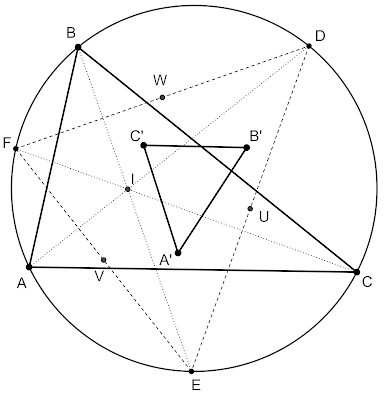
Figure 1


Lemma 1. If $ABC$ is a triangle and $DEF$ is its circumcircle mid-arc triangle, then

$$\boxed{\frac{[ABC]}{[DEF]}=\frac{2r}{R}.}\tag{2}$$

Proof. By property of inscribed angles, $\angle{BAF}=\angle{ACF}=\frac12\gamma$ and $\angle{CAE}=\frac12\beta$. It follows that
$$\begin{aligned}&\angle{EAF}=\alpha+\frac12\beta+\frac12\gamma\\&=\pi-\beta-\gamma+\frac12\beta+\frac12\gamma\\&=\pi-\frac12(\beta+\gamma).\end{aligned}$$
By the law of sines, 
$$\frac{EF}{\sin{(\pi-\frac12(\beta+\gamma))}}=\frac{EF}{\sin{\frac12(\beta+\gamma)}}=\frac{AF}{\sin{\frac12\gamma}}.\tag{3}$$
Since $\angle{AFC}=\beta$ and, again, by the law of sines, 
$$\frac{AF}{\sin{\frac12\gamma}}=\frac{b}{\sin{\beta}}.\tag{4}$$
From $(3)$ and $(4)$ we get
$$EF=\frac{b\sin{\frac12(\beta+\gamma)}}{\sin{\beta}}=2R\sin{\frac12(\pi-\alpha)}=2R\cos{\frac12\alpha}.\tag{5}$$
Analogously, we can find that
$$DF=2R\cos{\frac12\beta}\qquad ED=2R\cos{\frac12\gamma}.\tag{6}$$
Note that $\angle{DFC}=\frac12\alpha$ and $\angle{EFC}=\frac12\beta$, so $\angle{DFE}=\frac12(\alpha+\beta)$. Then the area of $DEF$ is given by
$$[DEF]=\frac{EF\cdot{DF}\sin{\frac12(\alpha+\beta)}}{2}=2R^2\cos{\frac12\alpha}\cos{\frac12\beta}\cos{\frac12\gamma}.\tag{7}$$
Elsewhere we have proved that $s=4R\cos{\frac12\alpha}\cos{\frac12\beta}\cos{\frac12\gamma}$ (for a proof, see section 3, c), here). As the area of $ABC$ can also be written as $[ABC]=rs$, we can rewrite it like this
$$[ABC]=4Rr\cos{\frac12\alpha}\cos{\frac12\beta}\cos{\frac12\gamma}.\tag{8}$$
Dividing $(8)$ by $(7)$ we get
$$\frac{[ABC]}{[DEF]}=\frac{2r}{R}.$$
$\square$
Lemma 2. Let $ABC$ be an triangle and $H$ its orthocenter. Let $l_a$, $l_b$ and $l_c$ be the perpendicular bisectors of sides $BC$, $AC$ and $AB$, respectively. Denote $H_1$, $H_2$ and $H_3$ the reflections of $H$ around $l_a$, $l_b$ and $l_c$, respectively. Then
 $$\boxed{\frac{[H_1H_2H_3]}{[ABC]}=\frac{(a^2-b^2)(a^2-c^2)}{b^2c^2}+\frac{(a^2-c^2)(b^2-c^2)}{a^2b^2}-\frac{(a^2-b^2)(b^2-c^2)}{a^2c^2}.}\tag{9}$$
Proof. Assume first that $ABC$ is acute. From figure 2, note that 
$$HH_3=2(\frac{c}{2}-AC_1).\tag{10}$$
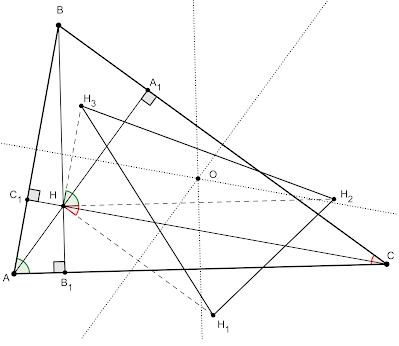
Figure 2

Let $CH$ intersect $AB$ in $C_1$. Applying the law of sines in the triangle $ACC_1$, we have that
$$b=\frac{AC_1}{\sin{(\frac{\pi}{2}-\alpha)}}=\frac{AC_1}{\cos{\alpha}}.$$
So, $AC_1=b\cos{\alpha}$. Substituting in $(10)$ and then substituting from the law of cosines $\cos{\alpha}=\frac{b^2+c^2-a^2}{2bc}$ we have
$$HH_3=2(\frac{c}{2}-b\cos{\alpha})=c-2b\cos{\alpha}=\frac{a^2-b^2}{c}.$$
Similarly, we get that $HH_1=\frac{b^2-c^2}{a}$ and $HH_2=\frac{a^2-c^2}{b}$. Now, note that 
$$[H_1H_2H_3]=[HH_2H_3]+[HH_1H_2]-[HH_1H_3].\tag{11}$$
As $HH_3$ and $HH_2$ are perpendicular to $l_c$ and $l_a$, respectively, then $\angle{H_2HH_3}=\alpha$ and similarly $\angle{H_2HH1}=\gamma$. Thus, equation $(11)$ can be written as follows
$$[H_1H_2H_3]=\frac{(a^2-b^2)(a^2-c^2)\sin{\alpha}}{2bc}+\frac{(a^2-c^2)(b^2-c^2)\sin{\gamma}}{2ab}-\frac{(a^2-b^2)(b^2-c^2)\sin{(\alpha+\gamma)}}{2ac}.\tag{12}$$
Dividing both sides of equation $(12)$ by $[ABC]=\frac12bc\sin{\alpha}=\frac12ab\sin{\gamma}=\frac12ac\sin{\beta}$ and taking into account that $\sin{(\alpha+\gamma)}=\sin{(\pi-\beta)}=\sin{\beta}$.
$$\frac{[H_1H_2H_3]}{[ABC]}=\frac{(a^2-b^2)(a^2-c^2)}{b^2c^2}+\frac{(a^2-c^2)(b^2-c^2)}{a^2b^2}-\frac{(a^2-b^2)(b^2-c^2)}{a^2c^2}.$$
$\square$

Remark. For simplicity, we have written the proof under the assumption that $ABC$ is acute, which is the configuration used in the argument above. The right and obtuse cases can be handled with the same identities after the usual minor adjustments.

Note that the terms on the right hand side of the equation $(9)$ are the products of the Mollweide's formulas. Substituting from Mollweide's formulas and applying the identity of sine of double angle, we can write the equation $(9)$ as follows
$$\boxed{\frac{[H_1H_2H_3]}{[ABC]}=\frac{\sin{(\alpha-\beta)}\sin{(\alpha-\gamma)}}{\sin{\gamma}\sin{\beta}}+\frac{\sin{(\alpha-\gamma)}\sin{(\beta-\gamma)}}{\sin{\alpha}\sin{\beta}}-\frac{\sin{(\alpha-\beta)}\sin{(\beta-\gamma)}}{\sin{\alpha}\sin{\gamma}}.}\tag{13}$$

Back to the main problem
It is well-known that the orthocenter of the circumcircle mid-arc triangle is the incenter of the reference triangle. So $IB\perp{FD}$. Moreover, because of properties of inscribed angles, $$\angle{IDF}=\angle{FCB}=\angle{FDB}=\frac12\gamma$$ 
and $$\angle{IFD}=\angle{CAD}=\angle{DAB}=\angle{DFB}=\frac12\alpha.$$ 
Hence, by $ASA$, $DFI\cong{DFB}$. As a consequence, $I$ is the reflection of $B$ around $FD$. As $B'$ is the reflection of $B$ around $W$, it follows that the perpendicular bisector of $FD$ must also bisect $IB'$, meaning that $B'$ is the reflection of the orthocenter of $DEF$, $I$, around the perpendicular bisector of $DF$. Similarly, we conclude that $A'$ and $C'$ are the reflections of $I$ around the perpendicular bisectors of $EF$ and $DE$, respectively. Now our goal will be to show that $\frac{[A'B'C']}{[DEF]}=1-\frac{2r}{R}$. Note that $\angle{EFD}=\frac12(\alpha+\beta)$, $\angle{EDF}=\frac12(\beta+\gamma)$ and  $\angle{DEF}=\frac12(\alpha+\gamma)$. Applying formula $(13)$ to triangles $A'B'C'$ and $DEF$ and substituting angles we have
$$\frac{[A'B'C']}{[DEF]}=\frac{\sin{\frac12(\alpha-\gamma)}\sin{\frac12(\beta-\gamma)}}{\cos{\frac12\beta}\cos{\frac12\alpha}}+\frac{\sin{\frac12(\beta-\gamma)}\sin{\frac12(\beta-\alpha)}}{\cos{\frac12\gamma}\cos{\frac12\alpha}}-\frac{\sin{\frac12(\alpha-\gamma)}\sin{\frac12(\beta-\alpha)}}{\cos{\frac12\gamma}\cos{\frac12\beta}}. \tag{14}$$
Note that the right hand side of the equation $(14)$ are, again, products of the Mollweide's formulas. Thus, we have
$$\begin{aligned}\frac{[A'B'C']}{[DEF]}&=\frac{(a-c)(b-c)}{ab}+\frac{(b-c)(b-a)}{ac}-\frac{(a-c)(b-a)}{bc}\\&=1-\frac{c(a+b-c)}{ab}+1-\frac{b(a-b+c)}{ac}+1-\frac{a(-a+b+c)}{bc}.\end{aligned}\tag{15}$$
Substituting from the half-angle formulas, 
$$\begin{aligned}\frac{[A'B'C']}{[DEF]}&=3-\frac{2a\cos^2{\frac12\alpha}+2b\cos^2{\frac12\beta}+2c\cos^2{\frac12\gamma}}{s}\\&=1-\frac{a\cos{\alpha}+b\cos{\beta}+c\cos{\gamma}}{s}.\end{aligned}\tag{16}$$
Substituting from the law of sines, factorizing and applying double-angle identity for sine,
$$\begin{aligned}\frac{[A'B'C']}{[DEF]}&=1-\frac{R(\sin{2\alpha}+\sin{2\beta}+\sin{2\gamma})}{s}.\end{aligned}\tag{17}$$
But $\sin{2\alpha}+\sin{2\beta}+\sin{2\gamma}=4\sin{\alpha}\sin{\beta}\sin{\gamma}=\frac{abc}{2R^3}=\frac{2rs}{R^2}$, hence
$$\frac{[A'B'C']}{[DEF]}=1-\frac{R}{s}\left(\frac{2rs}{R^2}\right)=1-\frac{2r}{R}.\tag{18}$$
Finally, from $(2)$ and $(18)$,
$$[ABC]+[A'B'C']=\frac{2r}{R}[DEF]+\left(1-\frac{2r}{R}\right)[DEF]=[DEF].$$
$\square$
Some corollary inequalities:
  • $\frac{(a^2-b^2)(a^2-c^2)}{b^2c^2}+\frac{(a^2-c^2)(b^2-c^2)}{a^2b^2}\geq\frac{(a^2-b^2)(b^2-c^2)}{a^2c^2}.$ (follows from $(9)$)
  • $\frac{\sin{(\alpha-\beta)}\sin{(\alpha-\gamma)}}{\sin{\gamma}\sin{\beta}}+\frac{\sin{(\alpha-\gamma)}\sin{(\beta-\gamma)}}{\sin{\alpha}\sin{\beta}}\geq\frac{\sin{(\alpha-\beta)}\sin{(\beta-\gamma)}}{\sin{\alpha}\sin{\gamma}}.$ (follows from $(13)$)
  • $\frac{c(a+b-c)}{ab}+\frac{b(a-b+c)}{ac}+\frac{a(-a+b+c)}{bc}\leq3.$ (follows from $(15)$) (this is IMO, 1964/2)
  • $a\cos{\alpha}+b\cos{\beta}+c\cos{\gamma}\leq{s}.$ (follows from $(16)$)
  • $\sin{2\alpha}+\sin{2\beta}+\sin{2\gamma}\leq\frac{s}{R}.$ (follows from $(17)$)
  • $R\geq{2r}.$ (This is Euler's Inequality! It follows from (18))
Relation $(1)$ seems like a good companion for property 4 of the Garcia-reflection triangle. See M. Dalcín, S. N. Kiss Some Properties of the García Reflection Triangles 119--126.

Update. Van Khea has generalized my problem. I have given a proof of his nice generalization which is available at Van Khea's areal problem.

domingo, 7 de agosto de 2022

A property of the Spieker point

Problem. Let $ABC$ be a triangle. Let $A'$ be on $BC$ such that $AA'$ is an internal angle bisector. Call $M$ the midpoint of $AA'$. Let $T$ be the point of tangency of $BC$ with the $A$-excircle. Prove that the Spieker center of $ABC$ lies on $MT$.

Proof. Let $D$, $E$ and $F$ be the midpoints of sides $AC$, $AB$ and $BC$, respectively. Let the angle bisector of $\angle{EDF}$ intersect $ET$ in $D'$ and $BC$ in $D''$. Similarly, let the angle bisector of $\angle{DEF}$ intersect $DT$ in $E'$, $AC$ in $E''$ and $BC$ in $E^*$. Call $S$ the intersection of $DD'$ and $EE'$. Since $AB\parallel{DF}$, a simple angle chase lead us to conclude that $\triangle{FDD''}$ is isosceles with $FD=FD''$. Moreover, since $DE\parallel{D''T}$ it follows that $\triangle{EDD'}\sim{\triangle{TD'D''}}$, from which we have


\[\frac{ED'}{D'T}=\frac{DE}{D''T}=\frac{DE}{D''F+FT}=\frac{\frac{a}{2}}{\frac{c}{2}+\frac{a}{2}-(s-b)}=\frac{a}{b}.\tag{1}\]
An analogous reasoning lead us to conclude that $\triangle{DEE''}$ is isosceles (with $DE=DE''$) and $\triangle{DEE'}\sim{\triangle{TE'E^*}}$, from which we obtain
\[\frac{TE'}{E'D}=\frac{TE^*}{ED}=\frac{CT+CE^*}{ED}=\frac{CT+CE''}{ED}=\frac{(s-b)+\frac{b}{2}-\frac{a}{2}}{\frac{a}{2}}=\frac{c}{a}.\tag{2}\]
Now, since $BC$ is the homothetic image of $ED$ with scale factor $2$, then $M$ must lies on $DE$ and by the Angle Bisector Theorem, 
\[\frac{DM}{ME}=\frac{AD}{AE}=\frac{b}{c}.\tag{3}\]
We want to show that $EE'$, $DD'$ and $MT$ are concurrent, so by invoking the Ceva's Theorem and substituting from $(1, 2, 3)$,
$$\frac{ED'}{D'T}\cdot{\frac{TE'}{E'D}}\cdot{\frac{DM}{ME}}=\frac{a}{b}\cdot{\frac{c}{a}}\cdot{\frac{b}{c}}=1.$$
This means $EE'$, $DD'$ and $MT$ are concurrent at $S$. Hence $S$ lies on $MT$.
$\square$

martes, 2 de agosto de 2022

Solution of a problem by Tran Viet Hung

 This is problem $037$ in this document by the Vietnamese geometer, Tran Viet Hung. 

Problem. Let $ABC$ be a triangle and $I$ its Incenter. Denote $D$, $E$ the points of tangency of incircle of $ABC$ with sides $BC$ and $AC$, respectively. Let $P$ be the intersection of the perpendicular of $AI$ at $A$ and $BC$. Construct $Q$ similarly. Denote $M$ and $N$ the midpoints of $AP$ and $BQ$, respectively. Prove that $MN$, $AB$ and $DE$ concur (see figure below). 


Lemma 1. Let $P'$ be the intersection of $AI$ with $BC$ and $Q'$ the intersection of $BI$ with $AC$. Denote $M'$ and $N'$ the midpoints of $AP'$ and $BQ'$, respectively. Call $X$ the intersection of $AN'$ with $BM'$. If $T'$ is the point of tangency of the $C$-excircle with $AB$, then $T'$, $X$ and $I$ are collinear. 

Proof. Here we'll be using standard notations, this is $BC=a$, $AC=b$, $AB=c$ and $s$ is semiperimeter. From the formula for the length of angle bisector we have
$$AP'=\frac{2\sqrt{bcs(s-a)}}{b+c}.\tag{1}$$
Moreover, it is well-known that
$$AI=\sqrt{\frac{bc(s-a)}{s}}.\tag{2}$$
From $(1)$ and $(2)$ follows that
$$M'I=AI-\frac{AP'}{2}=\sqrt{\frac{bc(s-a)}{s}}-\frac{\sqrt{bcs(s-a)}}{b+c}=\frac{1}{b+c}\cdot{\sqrt{\frac{bc(s-a)^3}{s}}}.$$
Similarly, we can derive an expression for $N'I$, 
$$N'I=BI-\frac{BQ'}{2}=\sqrt{\frac{ac(s-b)}{s}}-\frac{\sqrt{acs(s-b)}}{a+c}=\frac{1}{a+c}\cdot{\sqrt{\frac{ac(s-b)^3}{s}}}.$$
Invoking Ceva's theorem (using directed lengths), our goal now is to show that
$$\frac{AM'}{M'I}\cdot{\frac{N'I}{BN'}}\cdot{\frac{BT'}{AT'}}=1.\tag{3}$$
Since $AT'=(s-b)$ and $BT'=(s-a)$, equation $(3)$ can be re-written as
$$\frac{\sqrt{bcs(s-a)}}{\sqrt{\frac{bc(s-a)^3}{s}}}\cdot{\frac{\sqrt{\frac{ac(s-b)^3}{s}}}{\sqrt{acs(s-b)}}}\cdot{\frac{s-a}{s-b}}=\frac{s}{s-a}\cdot{\frac{s-b}{s}}\cdot{\frac{s-a}{s-b}}=1.$$
This means that $AN'$, $BM'$ and $IT'$ are concurrent at $X$. Hence $T'$, $X$ and $I$ must be collinear.
$\square$ 
Back to Hung's original problem
Call $I_c$ the $C$-excenter of $ABC$. By property of ex-centers, $\angle{IBI_c}=\angle{IAI_c}=90^\circ$, so $AP$ and $BQ$ must intersect at $I_c$. Denote $Y$ the intersection of $AN$ with $BM$ and $T$ the point of tangency of the incircle with $AB$. Then $Y$, $I_c$ and $T$ must be collinear since this is the extraverted version of Lemma 1. Now, suppose $DE$ and $MN$ intersect $AB$ at $R$ and $R'$, respectively. It is well-known that $AD$, $BE$ and $CT$ are concurrent at the Gergonne Point, so by property of harmonic bundles (see Lemma 2.5 here) we have
$$-1=(A, B; T, R)=(A, B; T, R'),$$
wich means $R=R'$, hence $MN$, $AB$ and $DE$ concur.
$\square$
Remark. Lemma 1 has given rise to a new special triangle, namely the Garcia-Moses triangle, published in the Encyclopedia of Triangle Centers.