miércoles, 28 de diciembre de 2022

Van Khea's areal problem

 The following problem is a generalization of my previous problem conjectured by Van Khea. We will give a proof.

The following problem is a generalization of my previous problem conjectured by Van Khea. We will give a proof. We will be using standard notation: $\lvert{BC}\rvert=a$, $\lvert{AC}\rvert=b$, $\lvert{AB}\rvert=c$; $\angle{BAC}=\alpha$, $\angle{ABC}=\beta$ and $\angle{BCA}=\gamma$. If $X$, $Y$ and $Z$ are the vertices of a triangle, we denote its area $[XYZ]$.

Problem. Let $ABC$ be a triangle and $P$ any point on the plane of $ABC$. Let $X$, $Y$ and $Z$ be points on sides $BC$, $AC$ and $AB$, respectively, chosen in the configuration shown in the figure; that is, 
$$X\in UC,\qquad Y\in VC,\qquad Z\in AW.$$
 Let $D$ be the reflection of $P$ around $X$. Similarly, define $E$ and $F$. Denote $U$, $V$ and $W$ the midpoints of sides $BC$, $AC$ and $AB$, respectively. Let $D'$ be the reflection of $D$ around $U$. Similarly, define $E'$ and $F'$. Prove that

$$[DEF]+[D'E'F']=[ABC].$$


Proof. Denote $AZ=g$, $BZ=h$, $BX=j$, $CX=k$, $CY=l$ and $AY=m$. The area of ​​triangle $XYZ$ can be expressed as follows $$[XYZ]=\frac12bc\sin{\alpha}-\frac12gm\sin{\alpha}-\frac12hj\sin{\beta}-\frac12kl\sin{\gamma}.$$ Since triangles $XYZ$ and $DEF$ are homothetic with scale factor $2$, it follows that $[DEF]=4[XYZ]$. Thus, we have \[{[DEF]}=2bc\sin{\alpha}-2gm\sin{\alpha}-2hj\sin{\beta}-2kl\sin{\gamma}.\tag{1}\] Dividing both sides of $(1)$ by $[ABC]$ we have \[\frac{[DEF]}{[ABC]}=4\left[1-\left(\frac{gm}{bc}+\frac{hj}{ca}+\frac{kl}{ab}\right)\right].\tag{2}\] Segments $UX$ and $PD'$ are homothetic with center at $D$ and scale factor $2$. It follows that $$PD'=2(j-\frac12a)=2j-a.$$ Similarly, we get $PE'=b-2l$ and $PF'=c-2g$. Since $UX$ and $PD'$ are homothetic segments, then $UX$ and $PD'$ are parallel and so are $VY$ and $PE'$. Hence $\angle{D'PE'}=\gamma$. Similarly, $\angle{D'PF'}=\beta$. So the area of triangle $D'E'F'$ is given by the expression $$\begin{aligned}{[D'E'F']}&=[D'PE']+[D'PF']-[E'F'P]\\&=\frac{(2j-a)(b-2l)\sin{\gamma}}{2}+\frac{(2j-a)(c-2g)\sin{\beta}}{2}-\frac{(b-2l)(c-2g)\sin{(\beta+\gamma)}}{2}.\end{aligned}$$ Taking into account that $\sin{(\beta+\gamma)}=\sin{(\pi-\alpha)}=\sin{\alpha}$ and dividing by $[ABC]$ we obtain \[\frac{[D'E'F']}{[ABC]}=\frac{(2j-a)(b-2l)}{ab}+\frac{(2j-a)(c-2g)}{ca}-\frac{(b-2l)(c-2g)}{bc}.\tag{3}\] Adding equations $(2)$ and $(3)$, expanding and factorizing, $$\frac{[DEF]}{[ABC]}+\frac{[D'E'F']}{[ABC]}=\frac{ca(4l+b)-4ga(m+l-b)-4j(b(g+h-c)+lc)-4klc}{abc}.$$ But $b=m+l$, $c=g+h$ and $a=j+k$, so $$\begin{aligned}\frac{[DEF]}{[ABC]}+\frac{[D'E'F']}{[ABC]}&=\frac{ca(4l+b)-4jlc-4klc}{abc}\\&=\frac{ca(4l+b)-4cl(j+k)}{abc}\\&=\frac{ca(4l+b)-4cla}{abc}\\&=1.\end{aligned}$$ Therefore, $$[DEF]+[D'E'F']=[ABC].$$ 
$\square$ 

Note: The point $P$ (and similarly $X$, $Y$ and $Z$) may cross the side lines of the triangle $ABC$ in points either interior or exterior to the sides. The reasoning in cases other than that considered above requires only minor adjustments.

Remark: This theorem remains valid if $P$ is an arbitrary point in three-dimensional space.

viernes, 23 de diciembre de 2022

Areal property of the circumcircle mid-arc triangle

 The following theorem is a property of the circumcircle mid-arc triangle which appears to be unknown.

We will be using standard notation: $\lvert{BC}\rvert=a$, $\lvert{AC}\rvert=b$, $\lvert{AB}\rvert=c$; $\angle{BAC}=\alpha$, $\angle{ABC}=\beta$ and $\angle{BCA}=\gamma$; $s$ for the semiperimeter; $R$ for the circumradius and $r$ for the inradius. If $X$, $Y$ and $Z$ are the vertices of a triangle, we denote its area $[XYZ]$.

Problem. Let $ABC$ be a triangle and $I$ its Incenter. Denote $\omega$ the circumcircle of $ABC$. Let $AI$ intersect $\omega$ again at $D$. Define $E$ and $F$ cyclically. Let $U$, $V$ and $W$ be the midpoints of $DE$, $EF$ and $FD$, respectively. Let $A'$ be the reflection of $A$ with respect to $V$. Define $B'$ and $C'$ cyclically (see figure 1). Then

$$[DEF]=[ABC]+[A'B'C'].\tag{1}$$
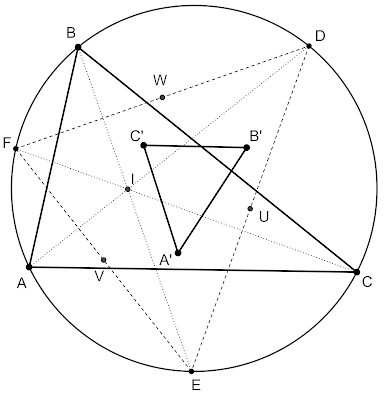
Figure 1


Lemma 1. If $ABC$ is a triangle and $DEF$ is its circumcircle mid-arc triangle, then

$$\boxed{\frac{[ABC]}{[DEF]}=\frac{2r}{R}.}\tag{2}$$

Proof. By property of inscribed angles, $\angle{BAF}=\angle{ACF}=\frac12\gamma$ and $\angle{CAE}=\frac12\beta$. It follows that
$$\begin{aligned}&\angle{EAF}=\alpha+\frac12\beta+\frac12\gamma\\&=\pi-\beta-\gamma+\frac12\beta+\frac12\gamma\\&=\pi-\frac12(\beta+\gamma).\end{aligned}$$
By the law of sines, 
$$\frac{EF}{\sin{(\pi-\frac12(\beta+\gamma))}}=\frac{EF}{\sin{\frac12(\beta+\gamma)}}=\frac{AF}{\sin{\frac12\gamma}}.\tag{3}$$
Since $\angle{AFC}=\beta$ and, again, by the law of sines, 
$$\frac{AF}{\sin{\frac12\gamma}}=\frac{b}{\sin{\beta}}.\tag{4}$$
From $(3)$ and $(4)$ we get
$$EF=\frac{b\sin{\frac12(\beta+\gamma)}}{\sin{\beta}}=2R\sin{\frac12(\pi-\alpha)}=2R\cos{\frac12\alpha}.\tag{5}$$
Analogously, we can find that
$$DF=2R\cos{\frac12\beta}\qquad ED=2R\cos{\frac12\gamma}.\tag{6}$$
Note that $\angle{DFC}=\frac12\alpha$ and $\angle{EFC}=\frac12\beta$, so $\angle{DFE}=\frac12(\alpha+\beta)$. Then the area of $DEF$ is given by
$$[DEF]=\frac{EF\cdot{DF}\sin{\frac12(\alpha+\beta)}}{2}=2R^2\cos{\frac12\alpha}\cos{\frac12\beta}\cos{\frac12\gamma}.\tag{7}$$
Elsewhere we have proved that $s=4R\cos{\frac12\alpha}\cos{\frac12\beta}\cos{\frac12\gamma}$ (for a proof, see section 3, c), here). As the area of $ABC$ can also be written as $[ABC]=rs$, we can rewrite it like this
$$[ABC]=4Rr\cos{\frac12\alpha}\cos{\frac12\beta}\cos{\frac12\gamma}.\tag{8}$$
Dividing $(8)$ by $(7)$ we get
$$\frac{[ABC]}{[DEF]}=\frac{2r}{R}.$$
$\square$
Lemma 2. Let $ABC$ be an triangle and $H$ its orthocenter. Let $l_a$, $l_b$ and $l_c$ be the perpendicular bisectors of sides $BC$, $AC$ and $AB$, respectively. Denote $H_1$, $H_2$ and $H_3$ the reflections of $H$ around $l_a$, $l_b$ and $l_c$, respectively. Then
 $$\boxed{\frac{[H_1H_2H_3]}{[ABC]}=\frac{(a^2-b^2)(a^2-c^2)}{b^2c^2}+\frac{(a^2-c^2)(b^2-c^2)}{a^2b^2}-\frac{(a^2-b^2)(b^2-c^2)}{a^2c^2}.}\tag{9}$$
Proof. Assume first that $ABC$ is acute. From figure 2, note that 
$$HH_3=2(\frac{c}{2}-AC_1).\tag{10}$$
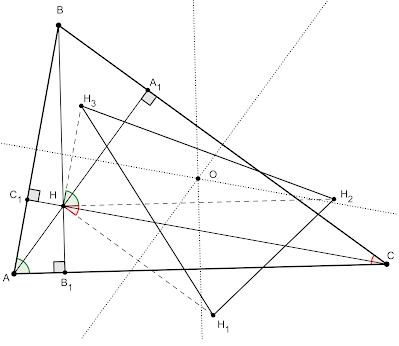
Figure 2

Let $CH$ intersect $AB$ in $C_1$. Applying the law of sines in the triangle $ACC_1$, we have that
$$b=\frac{AC_1}{\sin{(\frac{\pi}{2}-\alpha)}}=\frac{AC_1}{\cos{\alpha}}.$$
So, $AC_1=b\cos{\alpha}$. Substituting in $(10)$ and then substituting from the law of cosines $\cos{\alpha}=\frac{b^2+c^2-a^2}{2bc}$ we have
$$HH_3=2(\frac{c}{2}-b\cos{\alpha})=c-2b\cos{\alpha}=\frac{a^2-b^2}{c}.$$
Similarly, we get that $HH_1=\frac{b^2-c^2}{a}$ and $HH_2=\frac{a^2-c^2}{b}$. Now, note that 
$$[H_1H_2H_3]=[HH_2H_3]+[HH_1H_2]-[HH_1H_3].\tag{11}$$
As $HH_3$ and $HH_2$ are perpendicular to $l_c$ and $l_a$, respectively, then $\angle{H_2HH_3}=\alpha$ and similarly $\angle{H_2HH1}=\gamma$. Thus, equation $(11)$ can be written as follows
$$[H_1H_2H_3]=\frac{(a^2-b^2)(a^2-c^2)\sin{\alpha}}{2bc}+\frac{(a^2-c^2)(b^2-c^2)\sin{\gamma}}{2ab}-\frac{(a^2-b^2)(b^2-c^2)\sin{(\alpha+\gamma)}}{2ac}.\tag{12}$$
Dividing both sides of equation $(12)$ by $[ABC]=\frac12bc\sin{\alpha}=\frac12ab\sin{\gamma}=\frac12ac\sin{\beta}$ and taking into account that $\sin{(\alpha+\gamma)}=\sin{(\pi-\beta)}=\sin{\beta}$.
$$\frac{[H_1H_2H_3]}{[ABC]}=\frac{(a^2-b^2)(a^2-c^2)}{b^2c^2}+\frac{(a^2-c^2)(b^2-c^2)}{a^2b^2}-\frac{(a^2-b^2)(b^2-c^2)}{a^2c^2}.$$
$\square$

Remark. For simplicity, we have written the proof under the assumption that $ABC$ is acute, which is the configuration used in the argument above. The right and obtuse cases can be handled with the same identities after the usual minor adjustments.

Note that the terms on the right hand side of the equation $(9)$ are the products of the Mollweide's formulas. Substituting from Mollweide's formulas and applying the identity of sine of double angle, we can write the equation $(9)$ as follows
$$\boxed{\frac{[H_1H_2H_3]}{[ABC]}=\frac{\sin{(\alpha-\beta)}\sin{(\alpha-\gamma)}}{\sin{\gamma}\sin{\beta}}+\frac{\sin{(\alpha-\gamma)}\sin{(\beta-\gamma)}}{\sin{\alpha}\sin{\beta}}-\frac{\sin{(\alpha-\beta)}\sin{(\beta-\gamma)}}{\sin{\alpha}\sin{\gamma}}.}\tag{13}$$

Back to the main problem
It is well-known that the orthocenter of the circumcircle mid-arc triangle is the incenter of the reference triangle. So $IB\perp{FD}$. Moreover, because of properties of inscribed angles, $$\angle{IDF}=\angle{FCB}=\angle{FDB}=\frac12\gamma$$ 
and $$\angle{IFD}=\angle{CAD}=\angle{DAB}=\angle{DFB}=\frac12\alpha.$$ 
Hence, by $ASA$, $DFI\cong{DFB}$. As a consequence, $I$ is the reflection of $B$ around $FD$. As $B'$ is the reflection of $B$ around $W$, it follows that the perpendicular bisector of $FD$ must also bisect $IB'$, meaning that $B'$ is the reflection of the orthocenter of $DEF$, $I$, around the perpendicular bisector of $DF$. Similarly, we conclude that $A'$ and $C'$ are the reflections of $I$ around the perpendicular bisectors of $EF$ and $DE$, respectively. Now our goal will be to show that $\frac{[A'B'C']}{[DEF]}=1-\frac{2r}{R}$. Note that $\angle{EFD}=\frac12(\alpha+\beta)$, $\angle{EDF}=\frac12(\beta+\gamma)$ and  $\angle{DEF}=\frac12(\alpha+\gamma)$. Applying formula $(13)$ to triangles $A'B'C'$ and $DEF$ and substituting angles we have
$$\frac{[A'B'C']}{[DEF]}=\frac{\sin{\frac12(\alpha-\gamma)}\sin{\frac12(\beta-\gamma)}}{\cos{\frac12\beta}\cos{\frac12\alpha}}+\frac{\sin{\frac12(\beta-\gamma)}\sin{\frac12(\beta-\alpha)}}{\cos{\frac12\gamma}\cos{\frac12\alpha}}-\frac{\sin{\frac12(\alpha-\gamma)}\sin{\frac12(\beta-\alpha)}}{\cos{\frac12\gamma}\cos{\frac12\beta}}. \tag{14}$$
Note that the right hand side of the equation $(14)$ are, again, products of the Mollweide's formulas. Thus, we have
$$\begin{aligned}\frac{[A'B'C']}{[DEF]}&=\frac{(a-c)(b-c)}{ab}+\frac{(b-c)(b-a)}{ac}-\frac{(a-c)(b-a)}{bc}\\&=1-\frac{c(a+b-c)}{ab}+1-\frac{b(a-b+c)}{ac}+1-\frac{a(-a+b+c)}{bc}.\end{aligned}\tag{15}$$
Substituting from the half-angle formulas
$$\begin{aligned}\frac{[A'B'C']}{[DEF]}&=3-\frac{2a\cos^2{\frac12\alpha}+2b\cos^2{\frac12\beta}+2c\cos^2{\frac12\gamma}}{s}\\&=1-\frac{a\cos{\alpha}+b\cos{\beta}+c\cos{\gamma}}{s}.\end{aligned}\tag{16}$$
Substituting from the law of sines, factorizing and applying double-angle identity for sine,
$$\begin{aligned}\frac{[A'B'C']}{[DEF]}&=1-\frac{R(\sin{2\alpha}+\sin{2\beta}+\sin{2\gamma})}{s}.\end{aligned}\tag{17}$$
But $\sin{2\alpha}+\sin{2\beta}+\sin{2\gamma}=4\sin{\alpha}\sin{\beta}\sin{\gamma}=\frac{abc}{2R^3}=\frac{2rs}{R^2}$, hence
$$\frac{[A'B'C']}{[DEF]}=1-\frac{R}{s}\left(\frac{2rs}{R^2}\right)=1-\frac{2r}{R}.\tag{18}$$
Finally, from $(2)$ and $(18)$,
$$[ABC]+[A'B'C']=\frac{2r}{R}[DEF]+\left(1-\frac{2r}{R}\right)[DEF]=[DEF].$$
$\square$
Some corollary inequalities:
  • $\frac{(a^2-b^2)(a^2-c^2)}{b^2c^2}+\frac{(a^2-c^2)(b^2-c^2)}{a^2b^2}\geq\frac{(a^2-b^2)(b^2-c^2)}{a^2c^2}.$ (follows from $(9)$)
  • $\frac{\sin{(\alpha-\beta)}\sin{(\alpha-\gamma)}}{\sin{\gamma}\sin{\beta}}+\frac{\sin{(\alpha-\gamma)}\sin{(\beta-\gamma)}}{\sin{\alpha}\sin{\beta}}\geq\frac{\sin{(\alpha-\beta)}\sin{(\beta-\gamma)}}{\sin{\alpha}\sin{\gamma}}.$ (follows from $(13)$)
  • $\frac{c(a+b-c)}{ab}+\frac{b(a-b+c)}{ac}+\frac{a(-a+b+c)}{bc}\leq3.$ (follows from $(15)$) (this is IMO, 1964/2)
  • $a\cos{\alpha}+b\cos{\beta}+c\cos{\gamma}\leq{s}.$ (follows from $(16)$)
  • $\sin{2\alpha}+\sin{2\beta}+\sin{2\gamma}\leq\frac{s}{R}.$ (follows from $(17)$)
  • $R\geq{2r}.$ (This is Euler's Inequality! It follows from (18))
Relation $(1)$ seems like a good companion for property 4 of the Garcia-reflection triangle. See M. Dalcín, S. N. Kiss Some Properties of the García Reflection Triangles 119--126.

Update. Van Khea has generalized my problem. I have given a proof of his nice generalization which is available at Van Khea's areal problem.

domingo, 7 de agosto de 2022

A property of the Spieker point

Problem. Let $ABC$ be a triangle. Let $A'$ be on $BC$ such that $AA'$ is an internal angle bisector. Call $M$ the midpoint of $AA'$. Let $T$ be the point of tangency of $BC$ with the $A$-excircle. Prove that the Spieker center of $ABC$ lies on $MT$.

Proof. Let $D$, $E$ and $F$ be the midpoints of sides $AC$, $AB$ and $BC$, respectively. Let the angle bisector of $\angle{EDF}$ intersect $ET$ in $D'$ and $BC$ in $D''$. Similarly, let the angle bisector of $\angle{DEF}$ intersect $DT$ in $E'$, $AC$ in $E''$ and $BC$ in $E^*$. Call $S$ the intersection of $DD'$ and $EE'$. Since $AB\parallel{DF}$, a simple angle chase lead us to conclude that $\triangle{FDD''}$ is isosceles with $FD=FD''$. Moreover, since $DE\parallel{D''T}$ it follows that $\triangle{EDD'}\sim{\triangle{TD'D''}}$, from which we have


\[\frac{ED'}{D'T}=\frac{DE}{D''T}=\frac{DE}{D''F+FT}=\frac{\frac{a}{2}}{\frac{c}{2}+\frac{a}{2}-(s-b)}=\frac{a}{b}.\tag{1}\]
An analogous reasoning lead us to conclude that $\triangle{DEE''}$ is isosceles (with $DE=DE''$) and $\triangle{DEE'}\sim{\triangle{TE'E^*}}$, from which we obtain
\[\frac{TE'}{E'D}=\frac{TE^*}{ED}=\frac{CT+CE^*}{ED}=\frac{CT+CE''}{ED}=\frac{(s-b)+\frac{b}{2}-\frac{a}{2}}{\frac{a}{2}}=\frac{c}{a}.\tag{2}\]
Now, since $BC$ is the homothetic image of $ED$ with scale factor $2$, then $M$ must lies on $DE$ and by the Angle Bisector Theorem, 
\[\frac{DM}{ME}=\frac{AD}{AE}=\frac{b}{c}.\tag{3}\]
We want to show that $EE'$, $DD'$ and $MT$ are concurrent, so by invoking the Ceva's Theorem and substituting from $(1, 2, 3)$,
$$\frac{ED'}{D'T}\cdot{\frac{TE'}{E'D}}\cdot{\frac{DM}{ME}}=\frac{a}{b}\cdot{\frac{c}{a}}\cdot{\frac{b}{c}}=1.$$
This means $EE'$, $DD'$ and $MT$ are concurrent at $S$. Hence $S$ lies on $MT$.
$\square$

martes, 2 de agosto de 2022

Solution of a problem by Tran Viet Hung

 This is problem $037$ in this document by the Vietnamese geometer, Tran Viet Hung

Problem. Let $ABC$ be a triangle and $I$ its Incenter. Denote $D$, $E$ the points of tangency of incircle of $ABC$ with sides $BC$ and $AC$, respectively. Let $P$ be the intersection of the perpendicular of $AI$ at $A$ and $BC$. Construct $Q$ similarly. Denote $M$ and $N$ the midpoints of $AP$ and $BQ$, respectively. Prove that $MN$, $AB$ and $DE$ concur (see figure below). 


Lemma 1. Let $P'$ be the intersection of $AI$ with $BC$ and $Q'$ the intersection of $BI$ with $AC$. Denote $M'$ and $N'$ the midpoints of $AP'$ and $BQ'$, respectively. Call $X$ the intersection of $AN'$ with $BM'$. If $T'$ is the point of tangency of the $C$-excircle with $AB$, then $T'$, $X$ and $I$ are collinear. 

Proof. Here we'll be using standard notations, this is $BC=a$, $AC=b$, $AB=c$ and $s$ is semiperimeter. From the formula for the length of angle bisector we have
$$AP'=\frac{2\sqrt{bcs(s-a)}}{b+c}.\tag{1}$$
Moreover, it is well-known that
$$AI=\sqrt{\frac{bc(s-a)}{s}}.\tag{2}$$
From $(1)$ and $(2)$ follows that
$$M'I=AI-\frac{AP'}{2}=\sqrt{\frac{bc(s-a)}{s}}-\frac{\sqrt{bcs(s-a)}}{b+c}=\frac{1}{b+c}\cdot{\sqrt{\frac{bc(s-a)^3}{s}}}.$$
Similarly, we can derive an expression for $N'I$, 
$$N'I=BI-\frac{BQ'}{2}=\sqrt{\frac{ac(s-b)}{s}}-\frac{\sqrt{acs(s-b)}}{a+c}=\frac{1}{a+c}\cdot{\sqrt{\frac{ac(s-b)^3}{s}}}.$$
Invoking Ceva's theorem (using directed lengths), our goal now is to show that
$$\frac{AM'}{M'I}\cdot{\frac{N'I}{BN'}}\cdot{\frac{BT'}{AT'}}=1.\tag{3}$$
Since $AT'=(s-b)$ and $BT'=(s-a)$, equation $(3)$ can be re-written as
$$\frac{\sqrt{bcs(s-a)}}{\sqrt{\frac{bc(s-a)^3}{s}}}\cdot{\frac{\sqrt{\frac{ac(s-b)^3}{s}}}{\sqrt{acs(s-b)}}}\cdot{\frac{s-a}{s-b}}=\frac{s}{s-a}\cdot{\frac{s-b}{s}}\cdot{\frac{s-a}{s-b}}=1.$$
This means that $AN'$, $BM'$ and $IT'$ are concurrent at $X$. Hence $T'$, $X$ and $I$ must be collinear.
$\square$ 
Back to Hung's original problem
Call $I_c$ the $C$-excenter of $ABC$. By property of ex-centers, $\angle{IBI_c}=\angle{IAI_c}=90^\circ$, so $AP$ and $BQ$ must intersect at $I_c$. Denote $Y$ the intersection of $AN$ with $BM$ and $T$ the point of tangency of the incircle with $AB$. Then $Y$, $I_c$ and $T$ must be collinear since this is the extraverted version of Lemma 1. Now, suppose $DE$ and $MN$ intersect $AB$ at $R$ and $R'$, respectively. It is well-known that $AD$, $BE$ and $CT$ are concurrent at the Gergonne Point, so by property of harmonic bundles (see Lemma 2.5 here) we have
$$-1=(A, B; T, R)=(A, B; T, R'),$$
wich means $R=R'$, hence $MN$, $AB$ and $DE$ concur.
$\square$
Remark. Lemma 1 has given rise to a new special triangle, namely the Garcia-Moses triangle, published in the Encyclopedia of Triangle Centers.

jueves, 21 de julio de 2022

The jealous engineer problem


One day Tony woke up and didn't find his wife in the house.

— Where were you?

— I wanted to work out and just walked around the block. Look at my pedometer.

— What distance does the pedometer show?

—  Really Tony? again with your jealousy?

Angry, Tony snatches the pedometer from her and he read a distance traveled of $805$ meters.

— How many laps did you do?

— One lap!

— East or North?

 — Are you serious, Tony?

— East or North?

— East!

Tony had been the engineer in charge of paving the block years ago, and he knew that the four streets that made up the block were the same distance from the church where he married his wife. In addition, he remembered that the corners formed the following sequence of angles until he got back to his house: $60°$, $135°$, $85°$, $80°$ and that if his wife went east she must have traveled $200$ meters on the first street before to reach the $60°$- corner, a distance that he also remembered perfectly.

Was the wife lying? Justify your answer.

El problema del ingeniero celoso


Un día, Tony se despertó y no encontró a su esposa en la casa.

— ¿Dónde estabas?

— Quería ejercitarme y solo recorrí la cuadra. Mira mi podómetro.

— ¿Qué distancia marca el podómetro?

— ¿En serio, Tony? ¿otra vez con tus celos?

Airado, Tony le arrebata el podómetro y lee una distancia recorrida de $805$ metros.

— ¿Cuántas vueltas diste?

— ¡Una! ¡una vuelta!

— ¿Este o norte?

— ¿Hablas en serio, Tony?

— ¿Este o norte?

— ¡Este!

Tony había sido el ingeniero a cargo del asfaltado de la cuadra años atrás y sabía que las cuatro calles que formaban la cuadra estaban a la misma distancia de la iglesia donde se casó con su esposa. Además, recordaba que las esquinas formaban la siguiente secuencia de ángulos hasta llegar de vuelta a su casa: $60°$, $135°$, $85°$, $80°$ y que si su esposa partió hacia el este debió haber recorrido $200$ metros en la primera calle antes de llegar a la esquina de $60°$, distancia que también recordaba a la perfección. 

¿Mentía la esposa? Justifica tu respuesta.

domingo, 10 de julio de 2022

A generalization of Lami's theorem for 4 forces

 In physics, Lami's theorem is an equation relating the magnitudes of three coplanar, concurrent and non-collinear vectors, which keeps an object in static equilibrium, with the angles directly opposite to the corresponding vectors. According to the theorem

$$\frac{F_1}{\sin{\alpha}}=\frac{F_2}{\sin{\beta}}=\frac{F_3}{\sin{\gamma}}.\tag{1}$$

where $F_1$, $F_2$ and $F_3$ are the magnitudes of the three coplanar, concurrent and non-collinear vectors which keep the object in static equilibrium, and $\alpha$, $\beta$ and $\gamma$ are the angles directly opposite to the vectors (see Figure 1).

Figure 1. $\alpha$, $\beta$ and $\gamma$ are the angles directly opposite to the vectors $F_1$, $F_2$ and $F_3$

Lami's theorem is applied in static analysis of mechanical and structural systems. The theorem is named after Bernard Lamy. The proof of Lami's theorem is essentially based on the law of sines.

On the Internet there are hundreds of static equilibrium problems where they apply Lami's theorem to a three-force system, see for instance Dubey - Engineering Mechanics: Statics and Dynamics, section 3.10. Although Dubey's book is recent (2013) there is not a single equilibrium problem based on a four-force system. Coincidentally, the author of this note has come across questions on the Internet questioning the possibility of applying Lami's theorem for more than three forces. In this note we give a generalization of Lami's theorem for four forces.

Theorem 1 (Generalization). If four coplanar, concurrent and non-collinear forces act upon an object, and the object remains in static equilibrium, then

Figure 2. An example of the situation described in the theorem 1. 


$$AD\sin{\alpha'}+BC\sin{\gamma'}=AB\sin{\beta'}+CD\sin{\delta'}.\tag{2}$$

where $A$, $B$, $C$ and $D$ are the magnitudes of the four vectors and $\alpha'$, $\beta'$, $\gamma'$ and $\delta'$ are the angles between them (see Figure 2).

Proof. Consider the quadrilateral formed by the four vectors in such a manner that the head of one touches the tail of another (see Figure 3) and denote $\Delta$ its area. If $\alpha$, $\beta$, $\gamma$ and $\delta$ are the interior angles of the quadrilateral, then its area can be written as

Figure 3. Notice that if $\alpha$, $\beta$, $\gamma$ and $\delta$ are the interior angles of the quadrilateral formed by the four vectors, then $\alpha$ and $\alpha'$ are supplementary and similarly for $\beta'$, $\gamma'$ and $\delta'$

$$\Delta=\frac12AD\sin{\alpha}+\frac12BC\sin{\gamma}=\frac12AB\sin{\beta}+\frac12CD\sin{\delta}$$ 
and as $\sin{\alpha'}=\sin{(\pi-\alpha)}=\sin{\alpha}$, and similarly for $\beta'$, $\gamma'$ and $\delta'$, the relation in $(2)$ follows.

$\square$

Theorem 1 is a generalization in the sense that if one of the vectors vanishes, the relation we obtain is that of Lami's theorem. Indeed, for instance suppose $C=0$, then the relation $(2)$ reduces to
$$D\sin{\alpha'}=B\sin{\beta'},$$
which is Lami's theorem.

Remark. A generalization of Lami's theorem is given by H. Shekhar. However, this generalization is different since it only considers cyclic polygons with an odd number of sides.