The following theorem is a property of the circumcircle mid-arc triangle which appears to be unknown.
We will be using standard notation: $\lvert{BC}\rvert=a$, $\lvert{AC}\rvert=b$, $\lvert{AB}\rvert=c$; $\angle{BAC}=\alpha$, $\angle{ABC}=\beta$ and $\angle{BCA}=\gamma$; $s$ for the semiperimeter; $R$ for the circumradius and $r$ for the inradius. If $X$, $Y$ and $Z$ are the vertices of a triangle, we denote its area $[XYZ]$.
Problem. Let $ABC$ be a triangle and $I$ its Incenter. Denote $\omega$ the circumcircle of $ABC$. Let $AI$ intersect $\omega$ again at $D$. Define $E$ and $F$ cyclically. Let $U$, $V$ and $W$ be the midpoints of $DE$, $EF$ and $FD$, respectively. Let $A'$ be the reflection of $A$ with respect to $V$. Define $B'$ and $C'$ cyclically (see figure 1). Then
$$[DEF]=[ABC]+[A'B'C'].\tag{1}$$
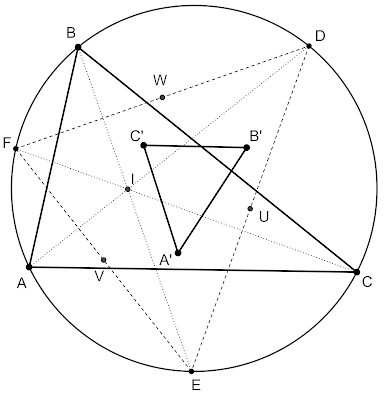 |
| Figure 1 |
Lemma 1. If $ABC$ is a triangle and $DEF$ is its circumcircle mid-arc triangle, then
$$\boxed{\frac{[ABC]}{[DEF]}=\frac{2r}{R}.}\tag{2}$$
Proof. By property of inscribed angles, $\angle{BAF}=\angle{ACF}=\frac12\gamma$ and $\angle{CAE}=\frac12\beta$. It follows that
$$\begin{aligned}&\angle{EAF}=\alpha+\frac12\beta+\frac12\gamma\\&=\pi-\beta-\gamma+\frac12\beta+\frac12\gamma\\&=\pi-\frac12(\beta+\gamma).\end{aligned}$$By the law of sines,
$$\frac{EF}{\sin{(\pi-\frac12(\beta+\gamma))}}=\frac{EF}{\sin{\frac12(\beta+\gamma)}}=\frac{AF}{\sin{\frac12\gamma}}.\tag{3}$$
Since $\angle{AFC}=\beta$ and, again, by the law of sines,
$$\frac{AF}{\sin{\frac12\gamma}}=\frac{b}{\sin{\beta}}.\tag{4}$$
From $(3)$ and $(4)$ we get
$$EF=\frac{b\sin{\frac12(\beta+\gamma)}}{\sin{\beta}}=2R\sin{\frac12(\pi-\alpha)}=2R\cos{\frac12\alpha}.\tag{5}$$
Analogously, we can find that
$$DF=2R\cos{\frac12\beta}\qquad ED=2R\cos{\frac12\gamma}.\tag{6}$$
Note that $\angle{DFC}=\frac12\alpha$ and $\angle{EFC}=\frac12\beta$, so $\angle{DFE}=\frac12(\alpha+\beta)$. Then the area of $DEF$ is given by
$$[DEF]=\frac{EF\cdot{DF}\sin{\frac12(\alpha+\beta)}}{2}=2R^2\cos{\frac12\alpha}\cos{\frac12\beta}\cos{\frac12\gamma}.\tag{7}$$
Elsewhere we have proved that $s=4R\cos{\frac12\alpha}\cos{\frac12\beta}\cos{\frac12\gamma}$ (for a proof, see section 3, c), here). As the area of $ABC$ can also be written as $[ABC]=rs$, we can rewrite it like this$$[ABC]=4Rr\cos{\frac12\alpha}\cos{\frac12\beta}\cos{\frac12\gamma}.\tag{8}$$
Dividing $(8)$ by $(7)$ we get
$$\frac{[ABC]}{[DEF]}=\frac{2r}{R}.$$
$\square$
Lemma 2. Let $ABC$ be an triangle and $H$ its orthocenter. Let $l_a$, $l_b$ and $l_c$ be the perpendicular bisectors of sides $BC$, $AC$ and $AB$, respectively. Denote $H_1$, $H_2$ and $H_3$ the reflections of $H$ around $l_a$, $l_b$ and $l_c$, respectively. Then
$$\boxed{\frac{[H_1H_2H_3]}{[ABC]}=\frac{(a^2-b^2)(a^2-c^2)}{b^2c^2}+\frac{(a^2-c^2)(b^2-c^2)}{a^2b^2}-\frac{(a^2-b^2)(b^2-c^2)}{a^2c^2}.}\tag{9}$$
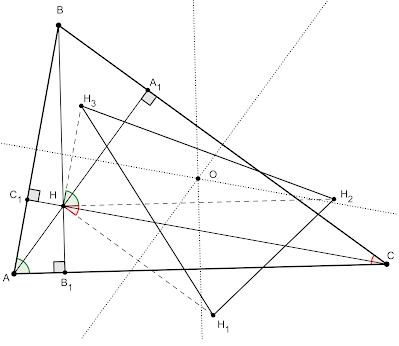
Proof. Assume first that $ABC$ is acute. From figure 2, note that
$$HH_3=2(\frac{c}{2}-AC_1).\tag{10}$$
 |
| Figure 2 |
Let $CH$ intersect $AB$ in $C_1$. Applying the law of sines in the triangle $ACC_1$, we have that
$$b=\frac{AC_1}{\sin{(\frac{\pi}{2}-\alpha)}}=\frac{AC_1}{\cos{\alpha}}.$$
So, $AC_1=b\cos{\alpha}$. Substituting in $(10)$ and then substituting from the law of cosines $\cos{\alpha}=\frac{b^2+c^2-a^2}{2bc}$ we have
$$HH_3=2(\frac{c}{2}-b\cos{\alpha})=c-2b\cos{\alpha}=\frac{a^2-b^2}{c}.$$
Similarly, we get that $HH_1=\frac{b^2-c^2}{a}$ and $HH_2=\frac{a^2-c^2}{b}$. Now, note that
$$[H_1H_2H_3]=[HH_2H_3]+[HH_1H_2]-[HH_1H_3].\tag{11}$$
As $HH_3$ and $HH_2$ are perpendicular to $l_c$ and $l_a$, respectively, then $\angle{H_2HH_3}=\alpha$ and similarly $\angle{H_2HH1}=\gamma$. Thus, equation $(11)$ can be written as follows
$$[H_1H_2H_3]=\frac{(a^2-b^2)(a^2-c^2)\sin{\alpha}}{2bc}+\frac{(a^2-c^2)(b^2-c^2)\sin{\gamma}}{2ab}-\frac{(a^2-b^2)(b^2-c^2)\sin{(\alpha+\gamma)}}{2ac}.\tag{12}$$
Dividing both sides of equation $(12)$ by $[ABC]=\frac12bc\sin{\alpha}=\frac12ab\sin{\gamma}=\frac12ac\sin{\beta}$ and taking into account that $\sin{(\alpha+\gamma)}=\sin{(\pi-\beta)}=\sin{\beta}$.
$$\frac{[H_1H_2H_3]}{[ABC]}=\frac{(a^2-b^2)(a^2-c^2)}{b^2c^2}+\frac{(a^2-c^2)(b^2-c^2)}{a^2b^2}-\frac{(a^2-b^2)(b^2-c^2)}{a^2c^2}.$$
$\square$
Remark. For simplicity, we have written the proof under the assumption that $ABC$ is acute, which is the configuration used in the argument above. The right and obtuse cases can be handled with the same identities after the usual minor adjustments.
Note that the terms on the right hand side of the equation $(9)$ are the products of the
Mollweide's formulas. Substituting from Mollweide's formulas and applying the identity of sine of double angle, we can write the equation $(9)$ as follows
$$\boxed{\frac{[H_1H_2H_3]}{[ABC]}=\frac{\sin{(\alpha-\beta)}\sin{(\alpha-\gamma)}}{\sin{\gamma}\sin{\beta}}+\frac{\sin{(\alpha-\gamma)}\sin{(\beta-\gamma)}}{\sin{\alpha}\sin{\beta}}-\frac{\sin{(\alpha-\beta)}\sin{(\beta-\gamma)}}{\sin{\alpha}\sin{\gamma}}.}\tag{13}$$
Back to the main problem
It is well-known that the orthocenter of the circumcircle mid-arc triangle is the incenter of the reference triangle. So $IB\perp{FD}$. Moreover, because of properties of inscribed angles, $$\angle{IDF}=\angle{FCB}=\angle{FDB}=\frac12\gamma$$
and $$\angle{IFD}=\angle{CAD}=\angle{DAB}=\angle{DFB}=\frac12\alpha.$$
Hence, by $ASA$, $DFI\cong{DFB}$. As a consequence, $I$ is the reflection of $B$ around $FD$. As $B'$ is the reflection of $B$ around $W$, it follows that the perpendicular bisector of $FD$ must also bisect $IB'$, meaning that $B'$ is the reflection of the orthocenter of $DEF$, $I$, around the perpendicular bisector of $DF$. Similarly, we conclude that $A'$ and $C'$ are the reflections of $I$ around the perpendicular bisectors of $EF$ and $DE$, respectively. Now our goal will be to show that $\frac{[A'B'C']}{[DEF]}=1-\frac{2r}{R}$. Note that $\angle{EFD}=\frac12(\alpha+\beta)$, $\angle{EDF}=\frac12(\beta+\gamma)$ and $\angle{DEF}=\frac12(\alpha+\gamma)$. Applying formula $(13)$ to triangles $A'B'C'$ and $DEF$ and substituting angles we have
$$\frac{[A'B'C']}{[DEF]}=\frac{\sin{\frac12(\alpha-\gamma)}\sin{\frac12(\beta-\gamma)}}{\cos{\frac12\beta}\cos{\frac12\alpha}}+\frac{\sin{\frac12(\beta-\gamma)}\sin{\frac12(\beta-\alpha)}}{\cos{\frac12\gamma}\cos{\frac12\alpha}}-\frac{\sin{\frac12(\alpha-\gamma)}\sin{\frac12(\beta-\alpha)}}{\cos{\frac12\gamma}\cos{\frac12\beta}}. \tag{14}$$
Note that the right hand side of the equation $(14)$ are, again, products of the
Mollweide's formulas. Thus, we have
$$\begin{aligned}\frac{[A'B'C']}{[DEF]}&=\frac{(a-c)(b-c)}{ab}+\frac{(b-c)(b-a)}{ac}-\frac{(a-c)(b-a)}{bc}\\&=1-\frac{c(a+b-c)}{ab}+1-\frac{b(a-b+c)}{ac}+1-\frac{a(-a+b+c)}{bc}.\end{aligned}\tag{15}$$
$$\begin{aligned}\frac{[A'B'C']}{[DEF]}&=3-\frac{2a\cos^2{\frac12\alpha}+2b\cos^2{\frac12\beta}+2c\cos^2{\frac12\gamma}}{s}\\&=1-\frac{a\cos{\alpha}+b\cos{\beta}+c\cos{\gamma}}{s}.\end{aligned}\tag{16}$$
Substituting from the law of sines, factorizing and applying double-angle identity for sine,
$$\begin{aligned}\frac{[A'B'C']}{[DEF]}&=1-\frac{R(\sin{2\alpha}+\sin{2\beta}+\sin{2\gamma})}{s}.\end{aligned}\tag{17}$$
But $\sin{2\alpha}+\sin{2\beta}+\sin{2\gamma}=4\sin{\alpha}\sin{\beta}\sin{\gamma}=\frac{abc}{2R^3}=\frac{2rs}{R^2}$, hence
$$\frac{[A'B'C']}{[DEF]}=1-\frac{R}{s}\left(\frac{2rs}{R^2}\right)=1-\frac{2r}{R}.\tag{18}$$
Finally, from $(2)$ and $(18)$,
$$[ABC]+[A'B'C']=\frac{2r}{R}[DEF]+\left(1-\frac{2r}{R}\right)[DEF]=[DEF].$$
$\square$
Some corollary inequalities:
- $\frac{(a^2-b^2)(a^2-c^2)}{b^2c^2}+\frac{(a^2-c^2)(b^2-c^2)}{a^2b^2}\geq\frac{(a^2-b^2)(b^2-c^2)}{a^2c^2}.$ (follows from $(9)$)
- $\frac{\sin{(\alpha-\beta)}\sin{(\alpha-\gamma)}}{\sin{\gamma}\sin{\beta}}+\frac{\sin{(\alpha-\gamma)}\sin{(\beta-\gamma)}}{\sin{\alpha}\sin{\beta}}\geq\frac{\sin{(\alpha-\beta)}\sin{(\beta-\gamma)}}{\sin{\alpha}\sin{\gamma}}.$ (follows from $(13)$)
- $\frac{c(a+b-c)}{ab}+\frac{b(a-b+c)}{ac}+\frac{a(-a+b+c)}{bc}\leq3.$ (follows from $(15)$) (this is IMO, 1964/2)
- $a\cos{\alpha}+b\cos{\beta}+c\cos{\gamma}\leq{s}.$ (follows from $(16)$)
- $\sin{2\alpha}+\sin{2\beta}+\sin{2\gamma}\leq\frac{s}{R}.$ (follows from $(17)$)
- $R\geq{2r}.$ (This is Euler's Inequality! It follows from (18))
Update. Van Khea has generalized my problem. I have given a proof of his nice generalization which is available at
Van Khea's areal problem.


